Introduction to Food Microbiology and Safety
Visualising Microbial Counts: From Fresh Produce to Spoiled Food – A Walk Through the Microbial World
Imagine a vast field, stretching for kilometers, with just a few people scattered across it – each person representing a bacterium on the surface of fresh vegetables. This visualisation brings the invisible microbial world to life. But as food spoils, that serene scene quickly turns into the crush of a crowded train. In this article, we explore how microbial counts on fresh and spoiled food compare, helping us better understand the numbers that tell us when food is safe to eat.
Total Aerobic Counts in Fresh Meat and Vegetables – Imagine People Standing 100 Meters Apart on a Grand Field
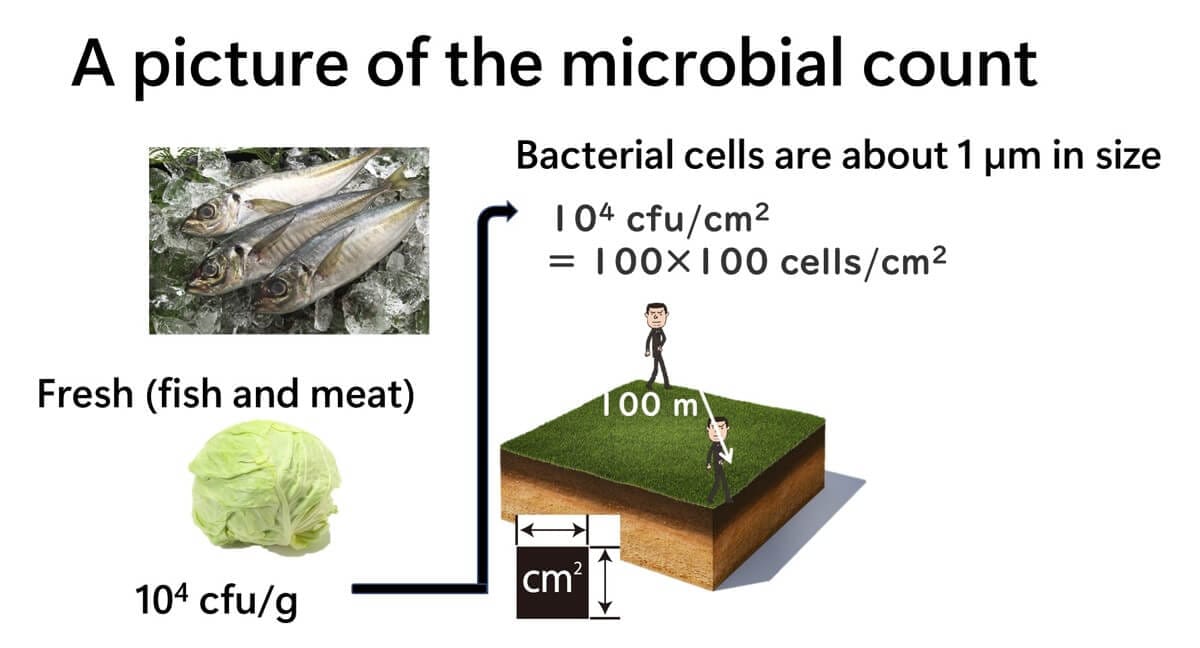
Generally, fresh fish and vegetables contain total aerobic counts ranging from 103 to 104 cfu/g. To put this into perspective, let's imagine a 1-square centimeter surface of vegetables as a vast grassland spanning 1 kilometer in all directions. Now, replace the bacteria on this surface with people standing in the grassland. As 1 cm is equal to 10,000 μm, and bacterial cell sizes are about 1 μm, it means there are approximately 100 cells within 10,000μm per 1 cm square. In other words, the distance between bacterial cells is approximately 100μm. Roughly calculating, if we consider a human's height as 1 meter, this would be equivalent to having one person standing every 100 meters in the grassland.
This rough calculation helps us visualize the number of bacteria present on the surface of fresh vegetables and fish.
Total Aerobic Counts in Spoiled Meat and Vegetables – Like Being in a Packed Train
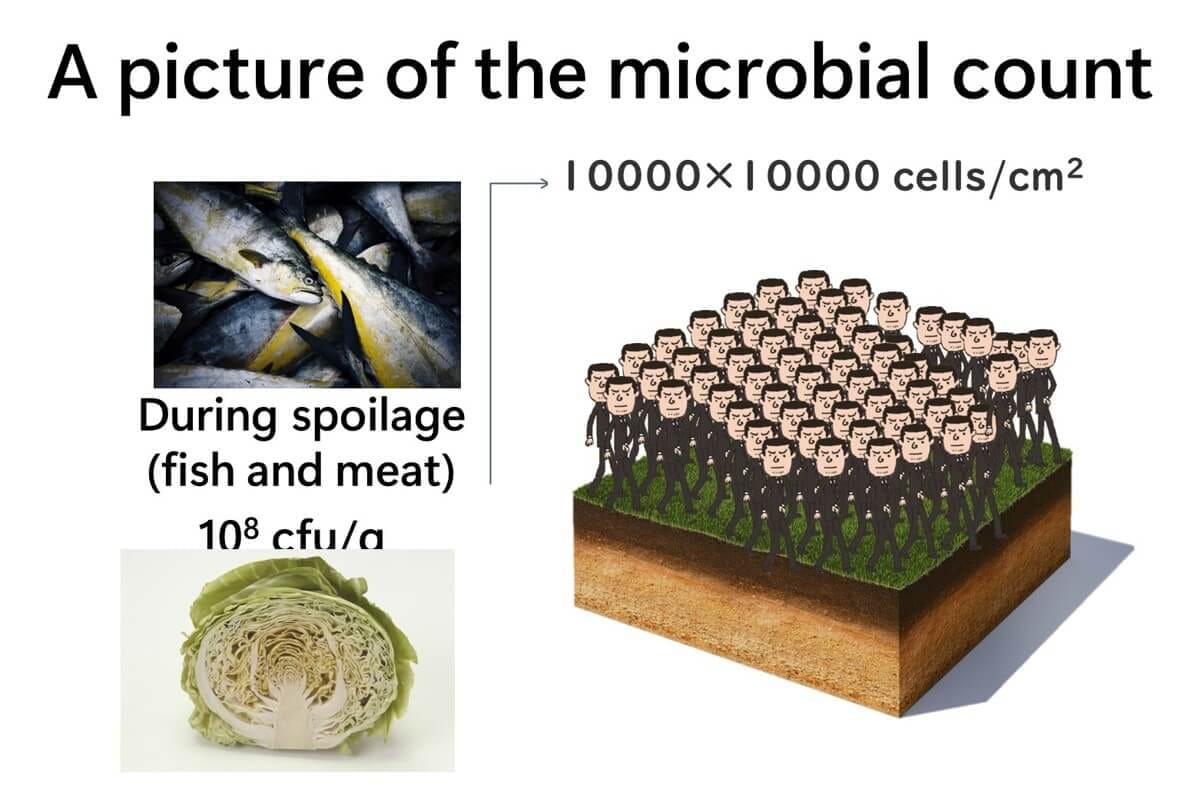
Now, let's consider what happens when vegetables and fish become spoiled. Typically, when food spoils, the microbial count increases to 107 to 108 cfu/g. This means there are 10,000 × 10,000 cells within one side of 10,000 μm, indicating that cells are densely packed together. To imagine this scenario, think of being on a crowded train or bus in Tokyo, with people pressed against each other shoulder to shoulder. This image represents the bacterial count when vegetables and fish are spoiled.
Around One-Third of Our Feces Consists of Microbial Cells
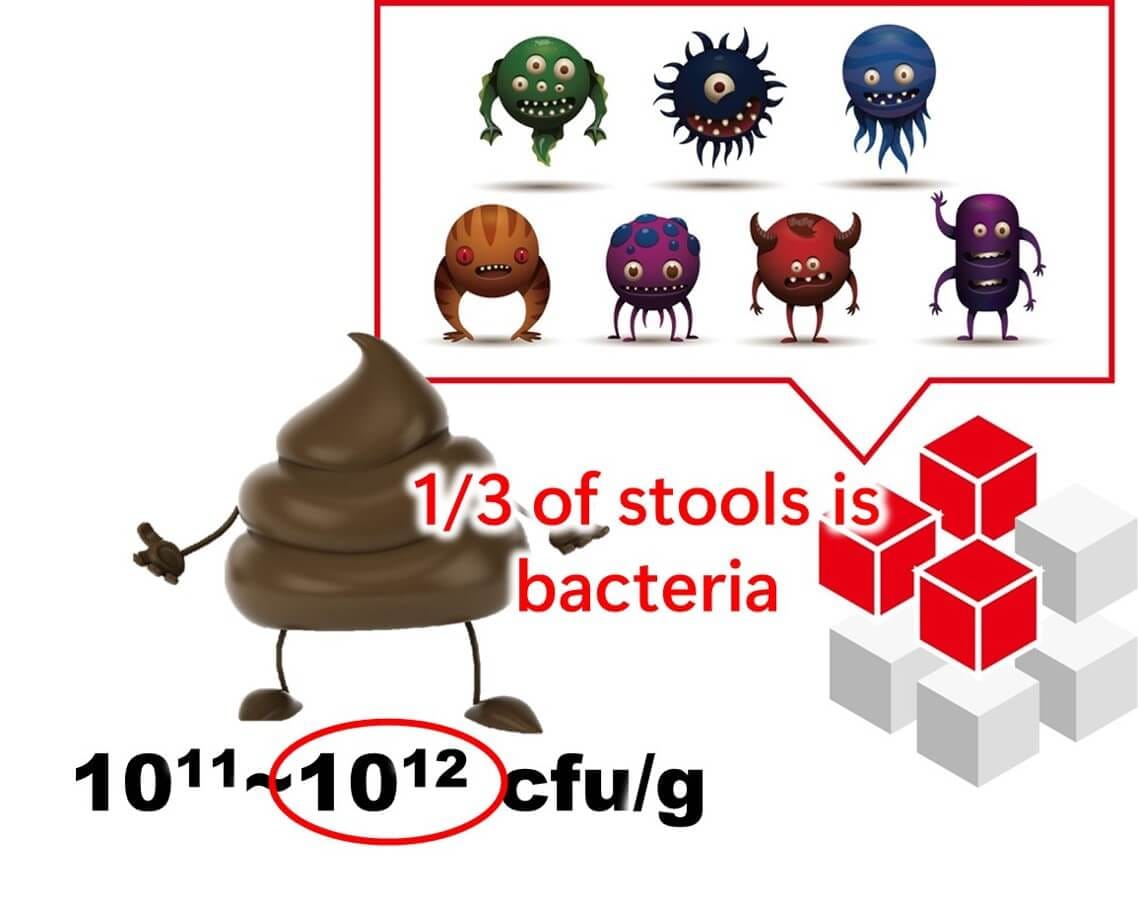
Now, let's visualize the microbial count in our feces. In general, feces contain around 1012 to 1013 cfu/g of bacteria. However, it's essential to note that theoretically, only a maximum of 1012 cells can fit in 1 cubic centimeter of feces. This is because within one side of 10,000μm, only 10,000 cells can be arranged. So, 10,000 cells × 10,000 cells × 10,000 cells = 1012. With 1012 to 1013 bacteria per gram, it means a significant portion of our feces is made up of microbes, accounting for about one-third of its weight.
Proper Interpretation of Total Aerobic Count Data Requires Basic Understanding of Microbial Counts Around Us
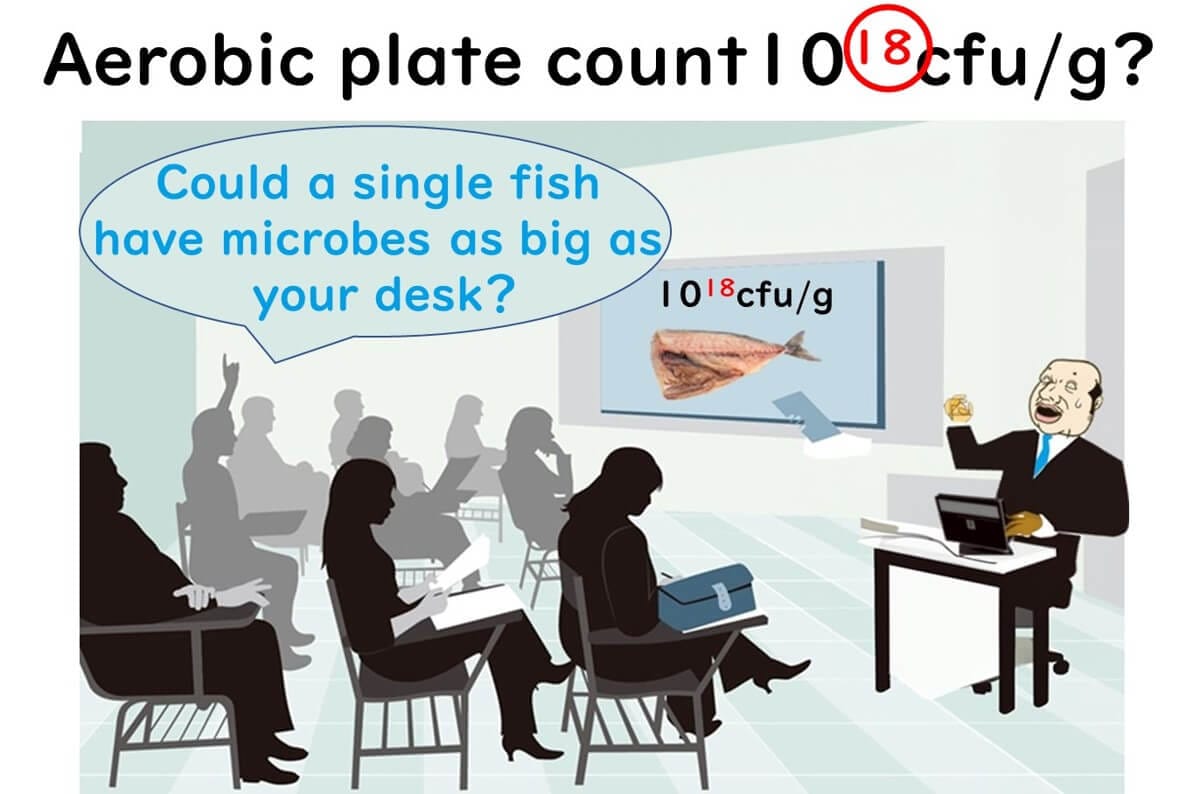
Once, one professor specialising in chemistry gave an oral presentation on microbiology-related issues at a conference. This professor presented a slide showing that 1018 cfu/g of micro-organisms were present in fish meat. Someone then asked the question. 'If this data is true, it means that in a small fish there is a quantity of micro-organisms the size of the desk in front of the professor.' That questioner said. Needless to say, the professor blushed and was perplexed.
Such errors are commonly made by those who lack a good understanding of microbiology. While it turned out that the professor's experimental data was incorrect, correctly interpreting total aerobic count data relies on having a basic understanding of the microbial counts in our surroundings, as discussed earlier.

Discover expert-led lessons in food microbiology designed for professionals and beginners alike.

Author of this Blog: Bon Kimura
Bon Kimura, Professor Emeritus at Tokyo University of Marine Science and Technology (TUMSAT), specializes in food microbiology. He obtained his PhD from Kyoto University and became a professor at TUMSAT in 2006, serving as Dean of the Faculty of Marine Science from 2012-2015. Kimura has published over 200 international papers on food safety, pathogens, and spoilage bacteria. He has received multiple awards, including the Japanese Society for Food Microbiology Award (2019). Kimura also served as an editor for the International Journal of Food Microbiology from 2012 to 2024, where he was the principal reviewer for 1,927 papers.

Copyright © Introduction to Food Microbiology and Safety All Rights Reserved.